



Median age: 7 years
High response rates in pediatric patients with high-grade disease1
Demonstrated efficacy at Day 281RYONCIL was studied in a multicenter, prospective, open-label, single-arm, Phase 3 trial of pediatric patients with SR-aGvHD Grade B to D (excluding Grade B skin alone),* following allogeneic hematopoietic stem cell transplantation (HSCT).1,2
View Full Study Design
At Day 28, 70% of patients achieved a response, including those with the most severe SR-aGvHD1
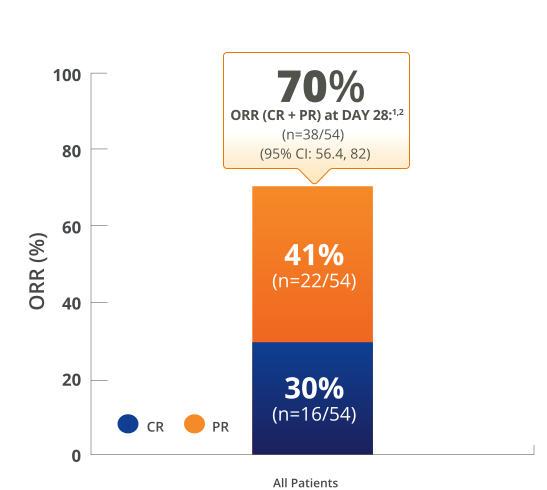
| 70% | OVERALL RESPONSE RATE (ORR)1 RYONCIL ORR (70%) compared with the prespecified null hypothesis of 45% (P=0.0003)1,2† |
High ORR at Day 28 in patients with high-grade SR-aGvHD at baseline1

CI=confidence interval; CR=complete response; IBMTR=International Blood Marrow Transplant Registry; PR=partial response.
*Per the IBMTR Severity Index criteria.
†Calculated for two-sided exact binomial confidence interval at the 95% level. P value calculated from binomial distribution, assuming a 0.45 (45%) predefined control ORR under the null hypothesis.
Patients who died, withdrew from the study, or required second-line treatment before Day 28 were considered nonresponders.
Additional data from the clinical study
Consistent results across clinical subgroups1-3At Day 28, the majority of patients achieved a response, regardless of disease severity, organ involvement, or age group.1-3*
View Full Study DesignOverall response at Day 28 by subgroup
Results were generally consistent across prespecified subgroups.1-3*
Disease severity
Disease severity
| Grade of aGvHD at Baseline | Day 28 ORR (%) |
|---|---|
| Grade B | 50% (n=3/6) |
| Grade C | 70% (n=16/23) |
| Grade D | 76% (n=19/25) |
Disease severity
| Minnesota Risk Score | Day 28 ORR (%) |
|---|---|
| Standard risk | 73% (n=11/15) |
| High risk | 69% (n=27/39) |
Organ involvement
Organ involvement
| Organ Involvement | Day 28 ORR (%) |
|---|---|
| Skin only | 86% (n=12/14) |
| Lower GI only | 67% (n=14/21) |
| Multiple organs | 63% (n=12/19) |
Age
Age
| Age Group | Day 28 ORR (%) |
|---|---|
| 0-7 years | 71% (n=20/28) |
| 8-12 years | 71% (n=10/14) |
| 13-17 years | 67% (n=8/12) |
Organ involvement and disease severity were secondary endpoints.3
LIMITATIONS: These subgroup results are based on small sample sizes and could represent chance findings, and they were not adjusted for multiplicity; interpret with caution.
GI=gastrointestinal.
*N is based on the number of enrolled patients who received RYONCIL.
Specifically studied in pediatric patients1,2
Pivotal clinical study designRYONCIL was studied in a multicenter, prospective, open-label, single-arm, Phase 3 trial of pediatric patients with SR-aGvHD Grade B to D (excluding Grade B skin alone),* following allogeneic HSCT.1,2
- SR-aGvHD was defined as progression within 3 days or no improvement within 7 days of steroid therapy (methylprednisolone 2 mg/kg/day or equivalent)1
- A total of 55 patients were enrolled, and 54 were treated with RYONCIL. Patients received at least 1 infusion of RYONCIL via IV at a dose of 2 x 10⁶ mesenchymal stromal cells/kg per infusion twice weekly for 4 consecutive weeks (up to 8 infusions)1,2
- Patients with partial or mixed response at Day 28 could receive weekly infusions for 4 additional weeks; those with CR at Day 28 who experienced recurrence could restart twice-weekly dosing for 4 weeks1
Patients previously treated with second-line therapy were excluded from the study1
Primary endpoint1-3- Day 28 ORR rate (CR rate and PR rate)

AGE

SEX
64% males; 36% females

Reason for HSCT
- 67% hematologic malignancy
- 33% nonmalignant diseases

aGvHD GRADE
- Grade B: 11% (excluded skin only)
- Grade C: 43%
- Grade D: 46%

Organ involvement
- Skin only: 26%
- Lower GI only: 39%
- Multiorgan: 35%

Race
- White: 56%
- Other race: 19%
- Black: 15%
- Asian: 6%
- American Indian or Alaska Native: 6%
- Hispanic: 33%
- Non-Hispanic: 65%
 89% of patients had severe SR-aGvHD (Grade C or D) at baseline1
*Per the IBMTR Severity Index criteria.

Which patients are candidates for RYONCIL?
Explore a series of case-based patient profiles to see how RYONCIL is redefining what’s possible in pediatric SR-aGvHD.
View Patient Profiles

